Long-term research · Grade 12

Kyte X4
When the aircraft
understands its own condition.

Distinguishing a harder mission from a less-healthy aircraft is one of the deepest problems in small aerospace. Kyte X4 exists to attack that problem.

Generation
04
Verb
Understand itself
Depends on
X1 · X2 · X3
Foundation for
FlightGuardian
Multi-signal reasoning Expected vs actual Residual analysis Anomaly diagnosis Health-aware endurance Multi-signal reasoning Expected vs actual Residual analysis Anomaly diagnosis
— The research question

Can an aircraft distinguish
between a harder mission
and an aircraft becoming less healthy?

CHAPTER 01
— Signals

What the aircraft listens to.

Kyte X4 continuously observes eight channels of its own behaviour. Each channel has a characteristic shape when the aircraft is healthy — and a different shape when it isn't.
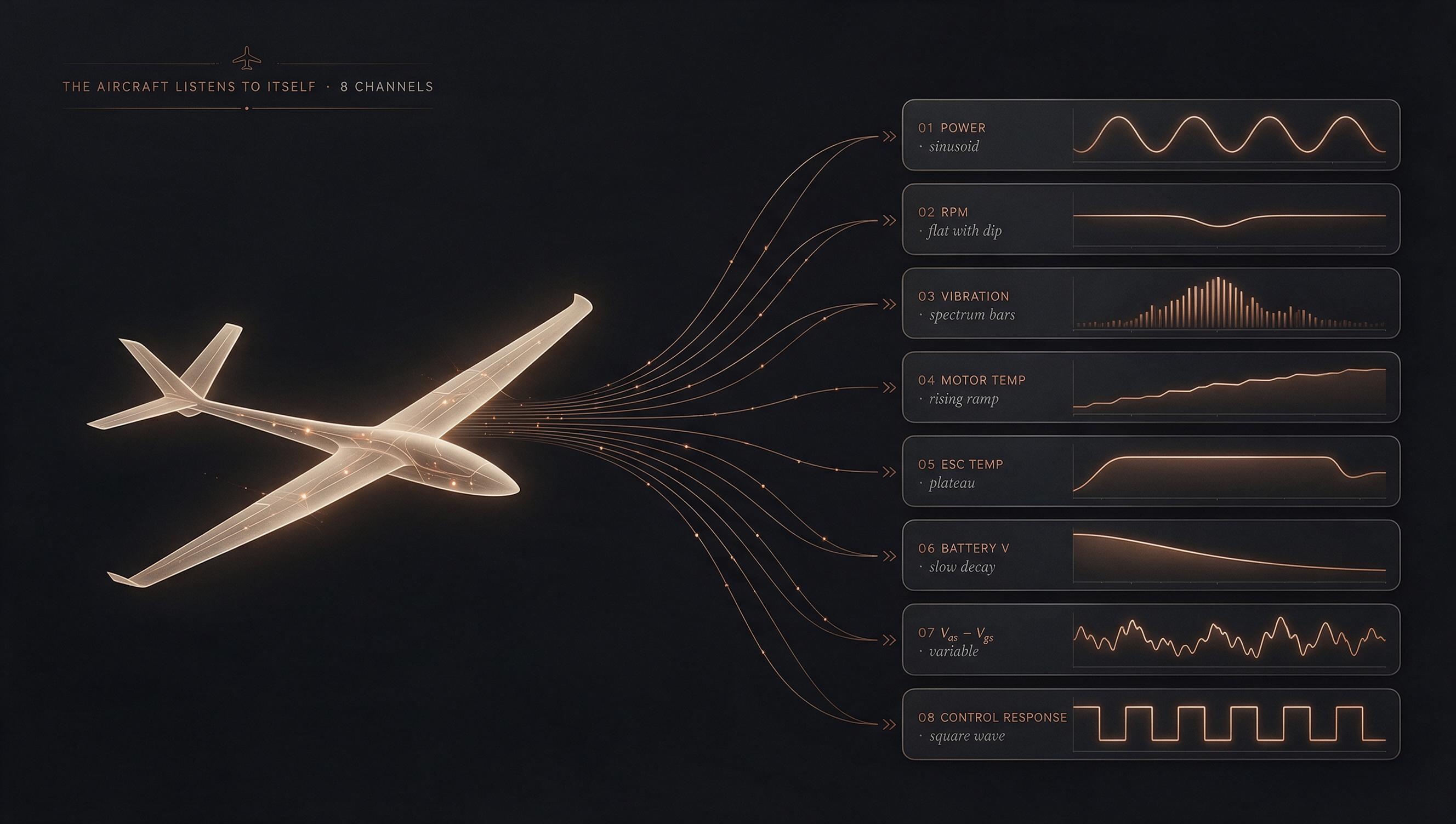
An aircraft with eight copper telemetry channels streaming from it into individual signal-waveform panels showing power, RPM, vibration spectrum, motor temperature, ESC temperature, battery voltage, airspeed–groundspeed delta, and control response.
FIG. 01 · Eight channels · The aircraft listens to itself SELF-TELEMETRY
01
Power & currentbus shunt
02
Motor RPMtach + command
03
Vibration spectrumIMU FFT
04
Motor temperatureinternal probe
05
ESC temperaturethermistor
06
Battery V & SoCBMS behaviour
07
Airspeed − groundwind estimate
08
Control responseactuator log
CHAPTER 02
— The interpretation problem

Same symptom.
Different causes.

An aircraft using more power than expected may be experiencing any of eight things — some coming from the world, some from itself, some from the sensors that measure it. The challenge is distinguishing them without ever getting a "correct" label in real time.
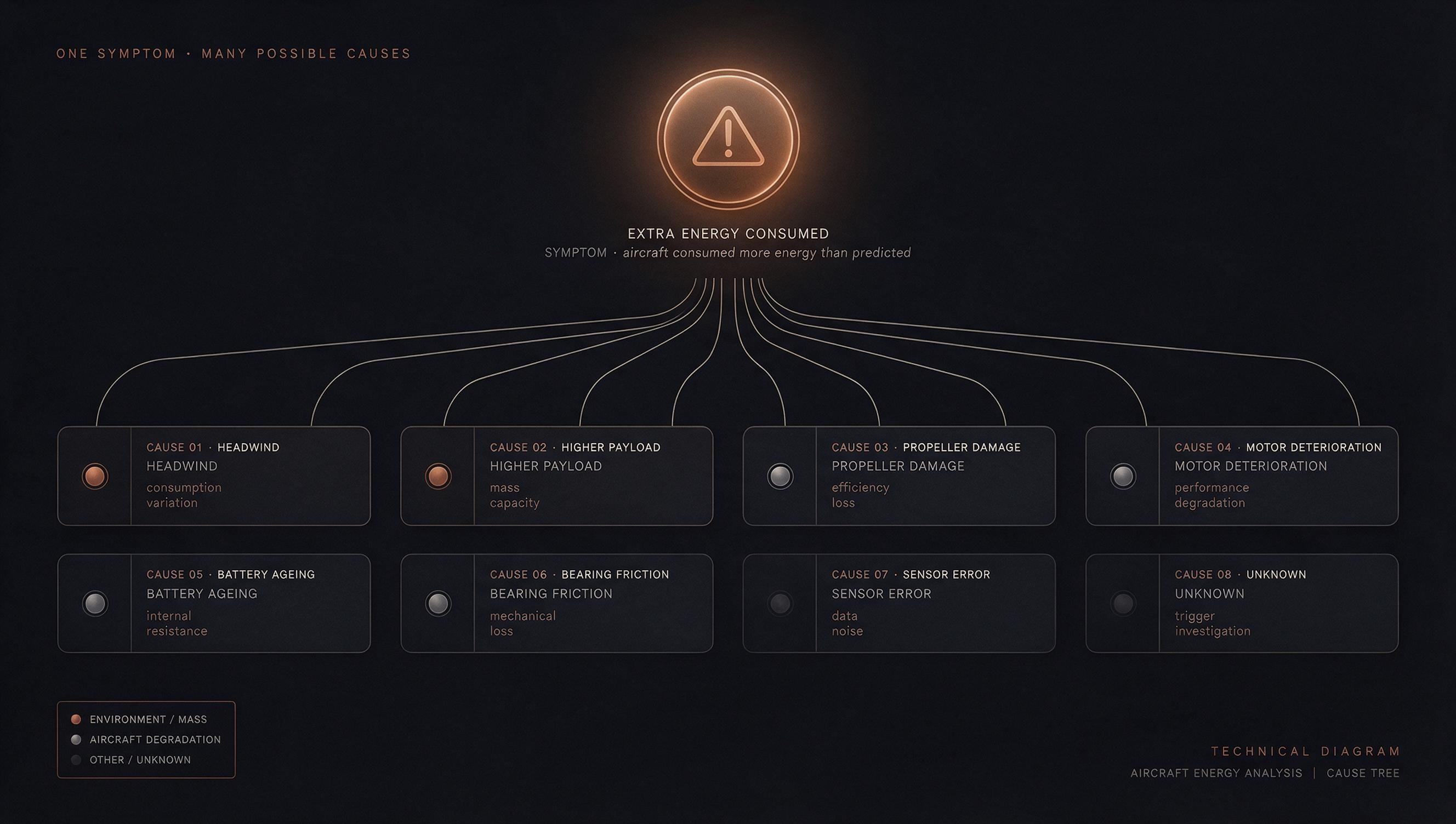
Diagnostic-tree diagram: at the top a single copper-glowing warning icon labeled 'Extra energy consumed', with eight thin branches fanning down to eight labeled cause cards (headwind, higher payload, propeller damage, motor deterioration, battery ageing, bearing friction, sensor error, unknown), each with a coloured category dot.
FIG. 02 · One symptom · Eight possible causes THE HARD DIAGNOSIS
Cause 01
Headwind

Environment. Mission is harder — the aircraft is fine.

Cause 02
Higher payload

Mass shifted. Fully expected extra energy consumption.

Cause 03
Propeller damage

Aircraft has degraded. Endurance should shrink.

Cause 04
Motor deterioration

Efficiency loss over time. Real, gradual, hidden.

Cause 05
Battery ageing

Less usable energy at the same nominal state of charge.

Cause 06
Bearing friction

Mechanical loss. The vibration signature shifts.

Cause 07
Sensor error

The measurement is wrong — the aircraft isn't.

Cause 08
Unknown

The most honest answer. Trigger investigation, not a diagnosis.

Environment / mass Aircraft degradation Sensor / unknown
CHAPTER 03
— The approach

Compare what the model expected
to what the aircraft actually did.

The X1–X3 model tells us what a healthy aircraft ought to do. The residual between prediction and reality carries the diagnostic signal. Reasoning about that residual, and feeding the interpretation back into an updated endurance estimate, is what makes X4 different.
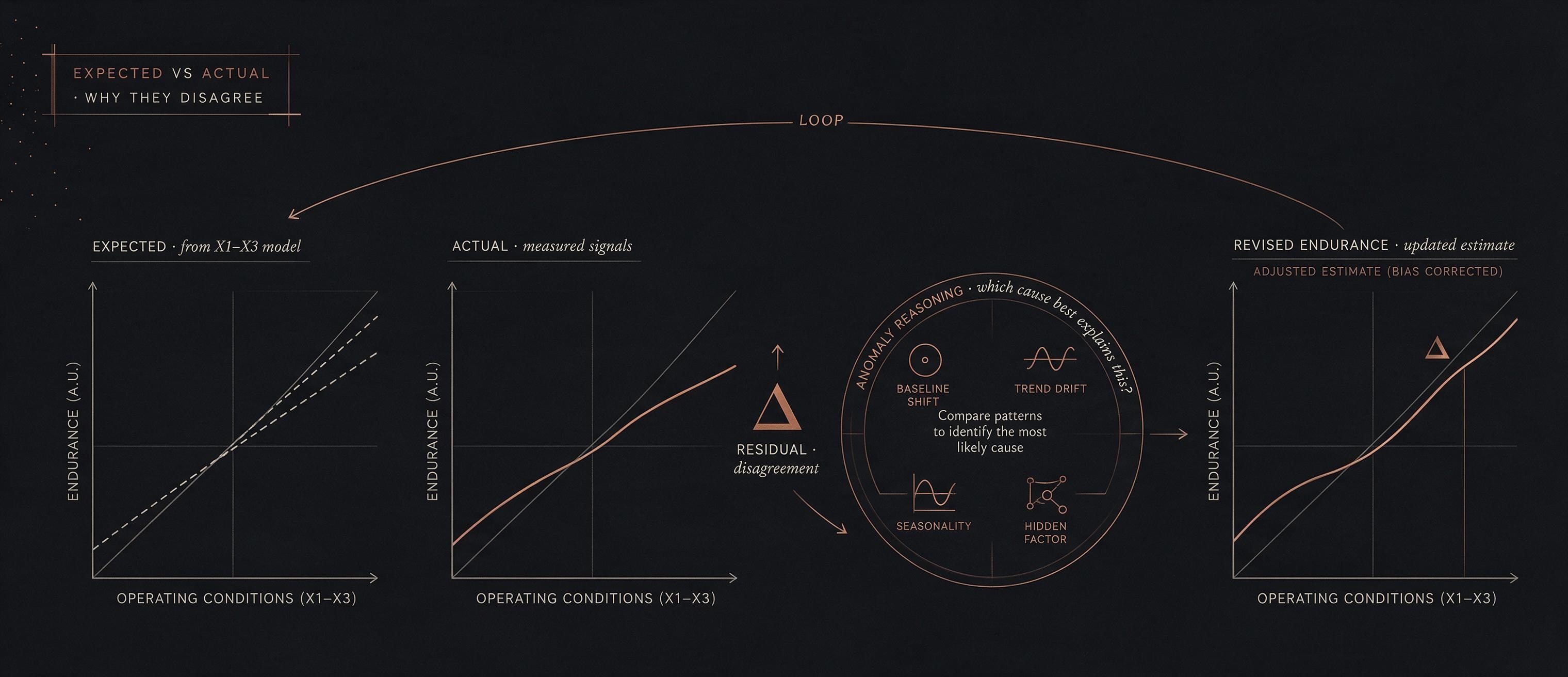
Expected-vs-actual comparison loop: EXPECTED graph (dashed, from X1–X3 model), ACTUAL graph (solid copper measured signals), a copper Δ symbol marked RESIDUAL, an anomaly-reasoning circle with four cause icons, then a REVISED ENDURANCE graph on the right, with a copper feedback arc looping back to the model.
FIG. 03 · Expected → Actual → Residual → Reasoning → Revised CLOSED-LOOP DIAGNOSIS
Step 01
Expected behaviour

From the aircraft model built in X1 – X3.

Step 02
Actual behaviour

Measured signals in real time.

Step 03
Residual

The disagreement between the two.

Step 04
Anomaly reasoning

Which cause best explains this residual?

Step 05
Revised endurance

Update the usable-endurance estimate.

Δ
— Where this leads

This becomes the foundation of FlightGuardian — an aircraft that can explain itself.

— From Kyte X4 forward

An aircraft that can
explain itself.

FlightGuardian → Four-year roadmap