Future development · Grade 10

Kyte X2
From measuring energy
to predicting it.

Once we know what Kyte X1 taught us, the next honest question is: can the aircraft, in real time, tell us how much useful flight it actually has left?

Generation
02
Verb
Predict
Depends on
X1 dataset
Timeline
Gr. 10
Physics-based prediction · f(V, m, ρ, config) Data-driven prediction · learned from flight logs Hybrid prediction · physics + ML residual correction Uncertainty · every estimate reports its own confidence Physics-based prediction · f(V, m, ρ, config) Data-driven prediction · learned from flight logs Hybrid prediction · physics + ML residual correction Uncertainty · every estimate reports its own confidence
CHAPTER 01
— Beyond percent

Battery percentage
is not a flight plan.

A percentage tells you what's in the pack. It doesn't tell you what the mission ahead will cost, or whether you'll make it home. Kyte X2 replaces the number with a real energy budget.
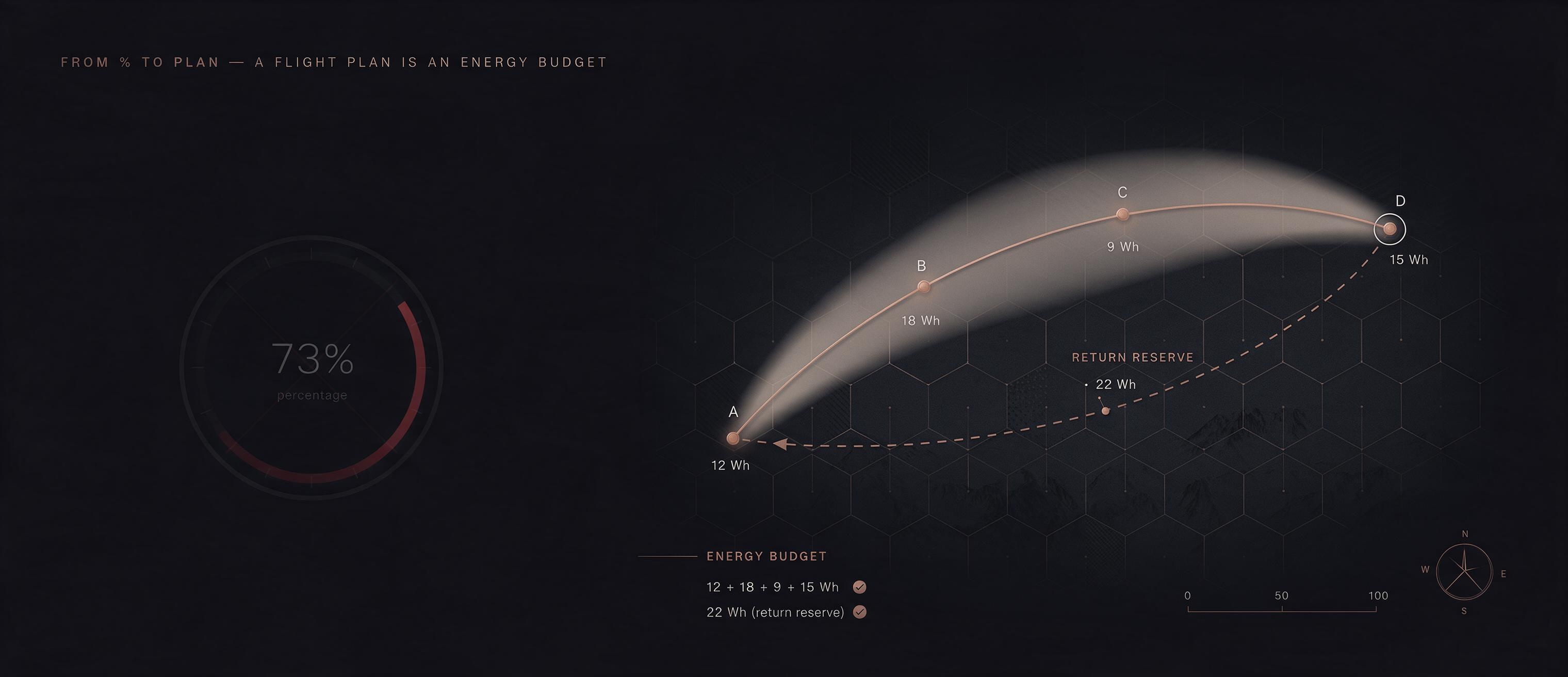
Left: dim battery percentage gauge crossed out. Right: rich flight-plan trajectory with 4 waypoints, per-leg energy costs, uncertainty envelope, and copper return-reserve arc back to base.
FIG. 01 · From % to plan · Waypoints · Per-leg cost · Return reserve FLIGHT PLAN IS AN ENERGY BUDGET
Approach 01
Physics-based

Mechanistic. Predict energy from the equations of flight. Transparent, verifiable — but blind to what the equations don't model.

Approach 02
Data-driven

Learned from flight logs. Captures the patterns physics misses. Accurate where flown before — unreliable outside the training envelope.

Approach 03
Hybrid

Physics gives the shape. A residual model fills the gap. Every prediction reports how much of it is trusted, and how much is guess.

CHAPTER 02
— Prediction pipeline

Three streams.
One honest answer.

Three parallel prediction approaches run at once — each with different assumptions, different failure modes. They converge into a single endurance estimate with an explicit confidence range.
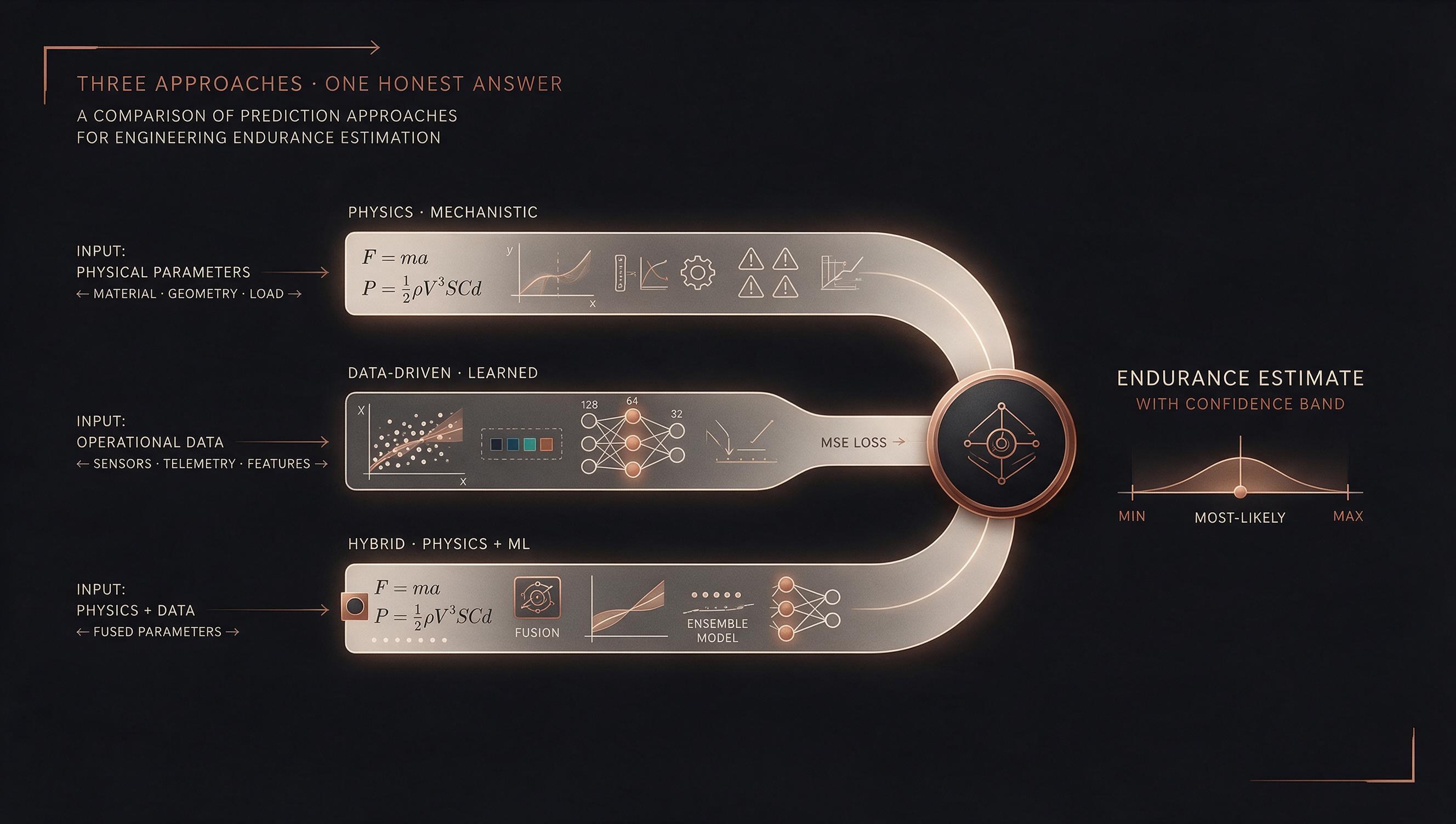
Three horizontal prediction pipelines (Physics-Mechanistic, Data-Driven-Learned, Hybrid-Physics+ML) flowing left-to-right and converging into a single endurance-estimate node with a min/most-likely/max confidence band.
FIG. 02 · Physics + Data + Hybrid → Endurance ± confidence CONVERGING ESTIMATES
— Inputs (4)
  • IN.01Flight condition · Vas, ρ, altitude, attitude
  • IN.02Battery state · SoC, voltage curve, temperature, cycles
  • IN.03Aircraft model · config, mass, aerodynamics (from X1)
  • IN.04Historical data · comparable flights, learned residuals
— Outputs (3)
  • OUT.01Expected flight time · t̂ with min · likely · max
  • OUT.02Mission energy · Em · per-leg breakdown
  • OUT.03Return reserve · Er · guaranteed home + margin
CHAPTER 03
— Potential outputs

Numbers the pilot can
actually trust.

Every predicted number carries an uncertainty. Every model version reports its historical error against real flights. Accuracy is claimed only after it is measured.
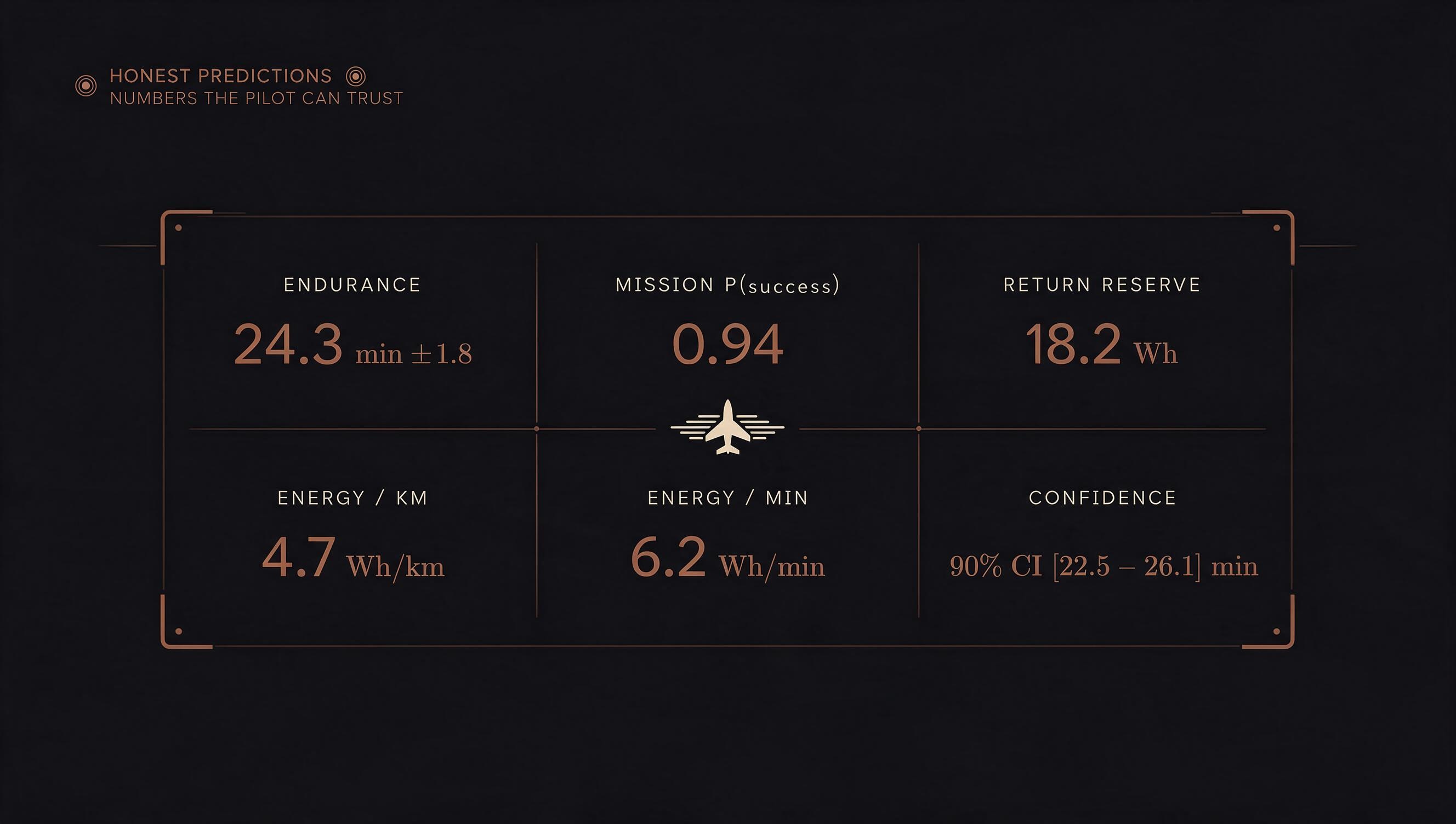
Cinematic cockpit-style HUD showing six honest predictions: endurance, mission probability, return reserve, energy per km, energy per minute, and a 90% confidence interval.
FIG. 03 · Cockpit HUD · Six honest readouts · Example values EVERY VALUE HAS UNCERTAINTY
— Estimated enduranceu± σ · minutes
— Mission completion probabilityP(success)0 → 1
— Return-to-home reserveErthWh
— Energy per kilometreE / kmWh/km
— Energy per minuteE / tWh/min
— Confidence range[t̂min, t̂max]90% CI
σ
— The promise

We will never imply accuracy until it has been experimentally validated.

— Next in the program

Once we can predict,
we can optimize.

Kyte X3 · Optimize → Endurance Intelligence