Adaptive airspeed
Fly the airspeed that minimizes energy for the current wind and mission — not a fixed cruise number.
Once we can predict endurance, the next question is whether the aircraft can change how it flies to extend the useful endurance it has.
An aircraft is not a fixed thing flying a fixed plan. It is a system with six real decisions it can make continuously. Kyte X3 exists to study which decisions actually earn more useful flight time.
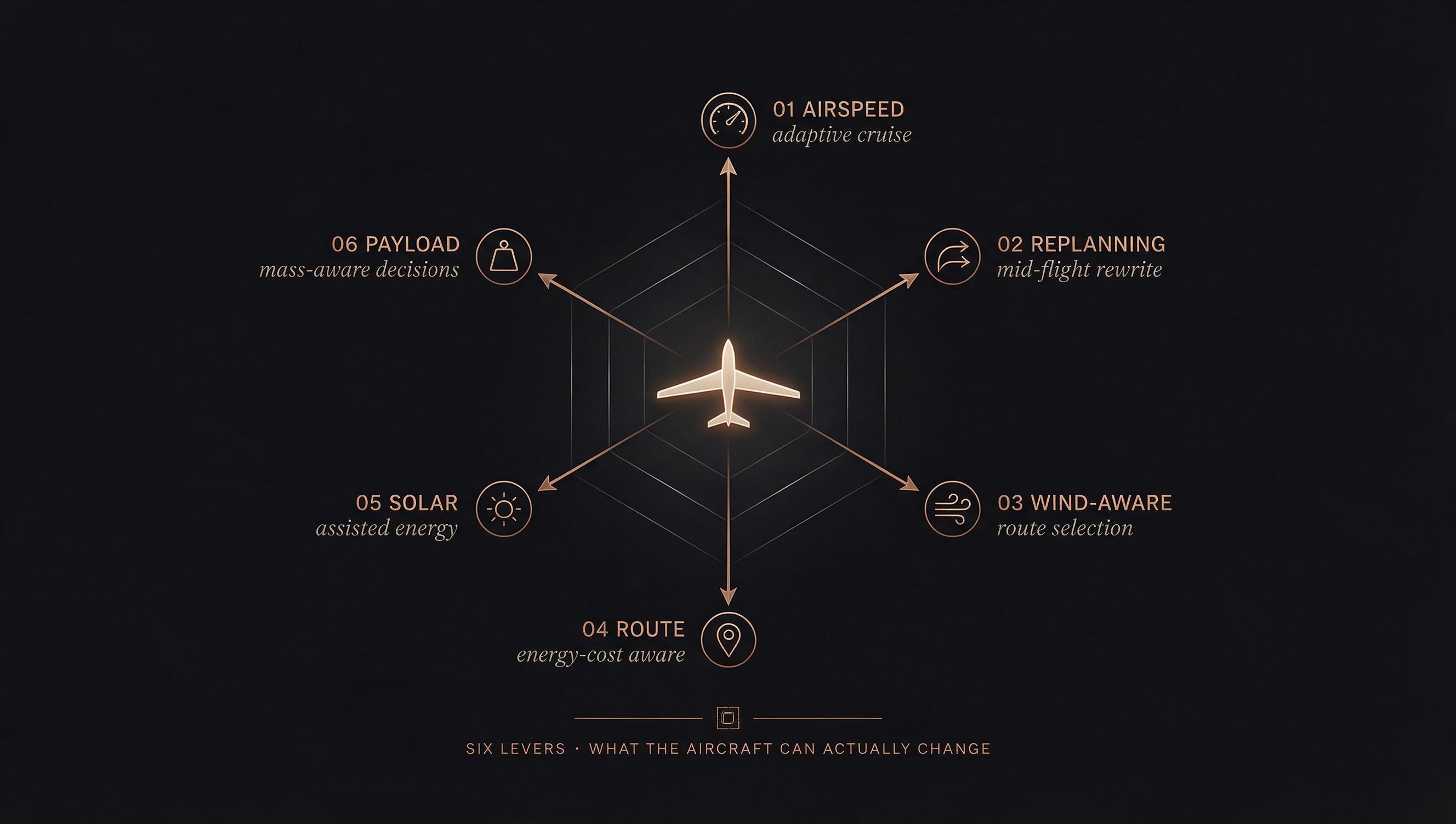
Fly the airspeed that minimizes energy for the current wind and mission — not a fixed cruise number.
Rewrite the flight plan mid-flight when the energy budget disagrees with the original plan.
Use the estimated wind field to choose the route and altitude that spends the fewest joules.
Route selection driven by predicted energy cost, not just distance on a map.
A second, environmental energy source — with real trade-offs to characterize honestly.
Mission decisions shaped by current mass and how it affects predicted endurance.
Add solar energy to the aircraft and the fundamental question changes. It is no longer "how fast is the battery draining?" — it is "which side of the beam wins right now?"
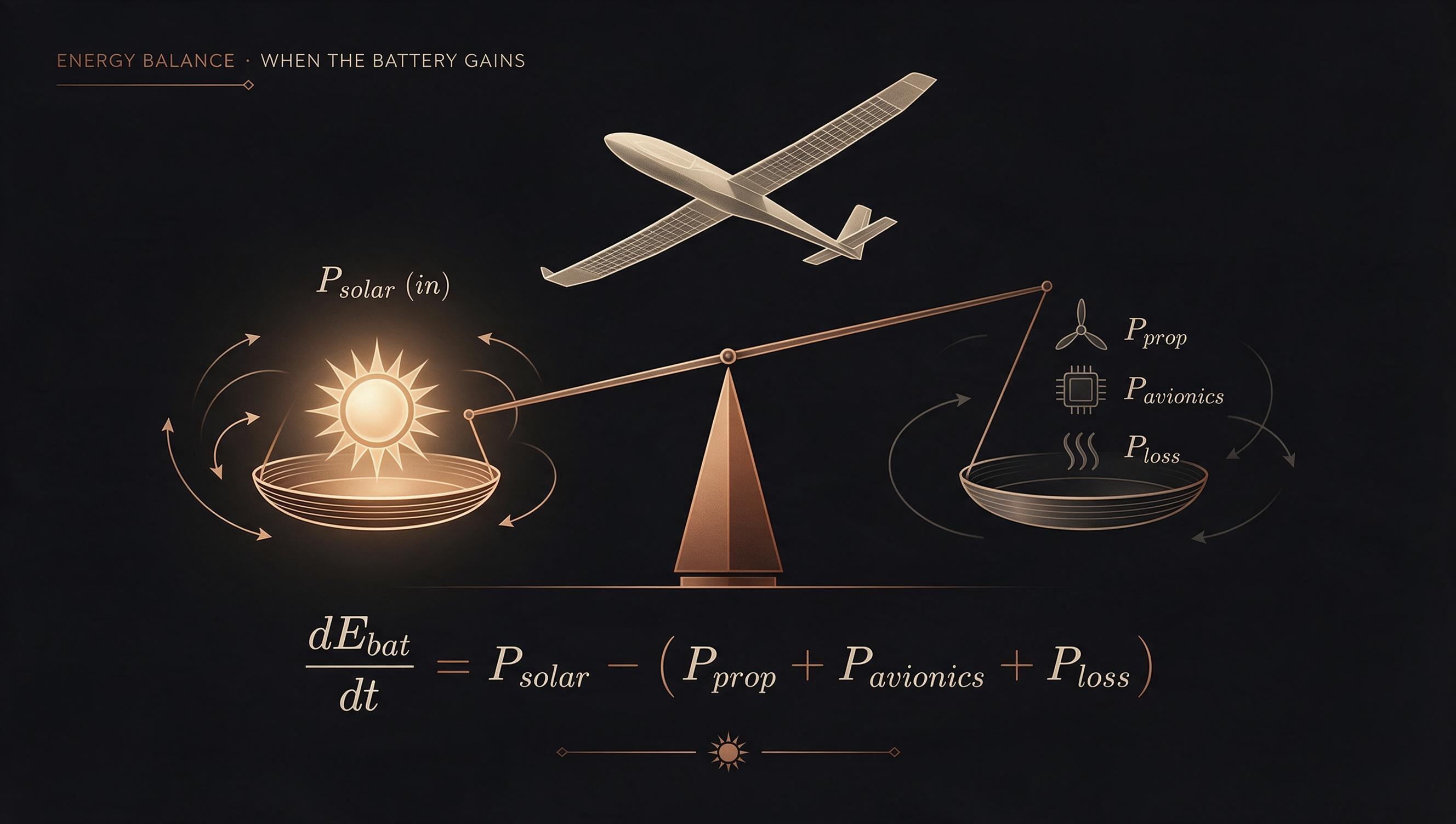
The battery gains when solar exceeds total power draw. Every optimization lever in Chapter 01 can shift the sign of that number — pulling more energy in, or paying less energy out.
Five open engineering questions grow out of the six levers and the solar equation. The purpose of Kyte X3 is not to guess at answers — it is to build the aircraft that can measure them.
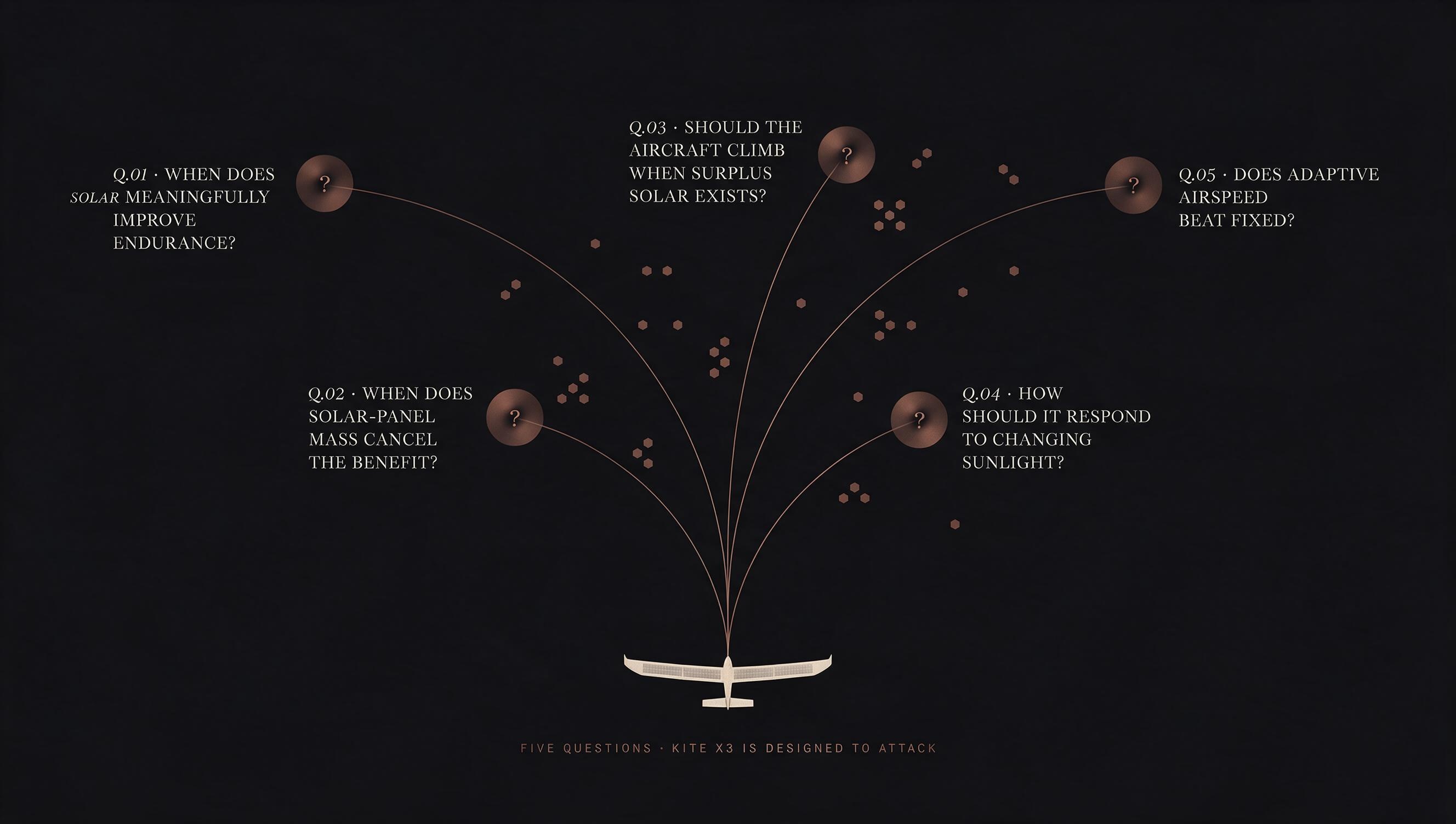
When does solar energy meaningfully improve endurance?
When does added solar-panel mass cancel the benefit?
Should an aircraft climb when surplus solar power exists?
How should the aircraft respond to changing sunlight?
Does adaptive airspeed beat fixed-airspeed on real missions?
Kyte X3 does not know the answers. Kyte X3 is how we find out.